About All Tours Full Day ToursSafari ToursHalf Day ToursFrom Port Elizabeth Directions Hours & Fees Guides
Find Tours 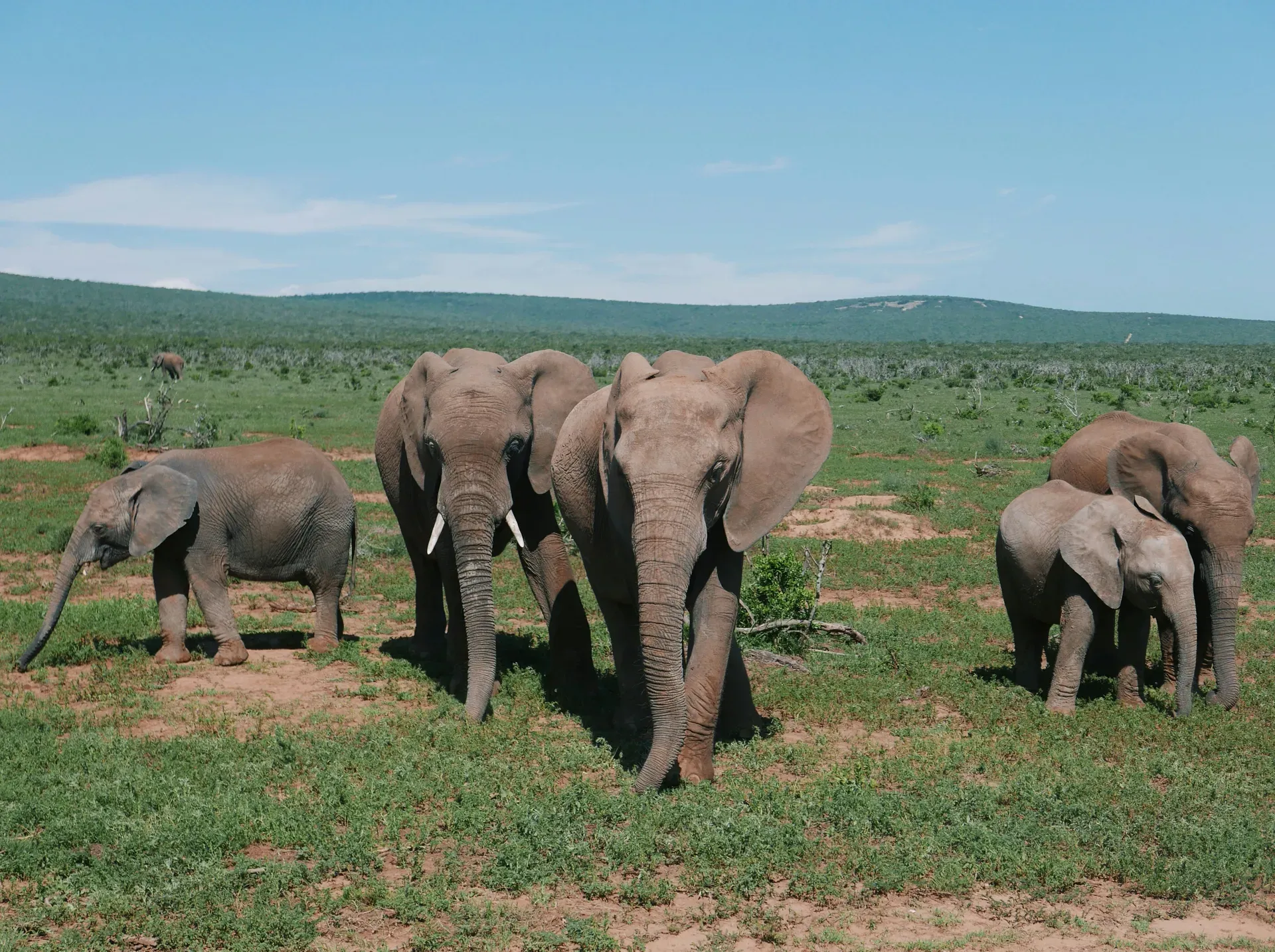
Seventy-two kilometres north-east of Gqeberha in South Africa's Eastern Cape, Addo Elephant National Park protects more than 600 elephants — descendants of just 11 survivors — across 1,640 km² of malaria-free Big Five country.
Addo Elephant National Park is a SANParks reserve in South Africa's Eastern Cape, 72 km north-east of Gqeberha, and it holds more than 600 elephants — every one of them descended from the 11 animals alive when the park was proclaimed in 1931. That turnaround is why the park exists in the public imagination. It's also completely malaria-free, which is why families and first-time safari-goers pick it over Kruger.
The park covers about 1,640 km², making it South Africa's third-largest, and it runs from the Karoo interior to the Indian Ocean. Roughly five biomes fall inside the boundary: arid country around Darlington Dam, the Zuurberg Mountains, the dense spekboom valley bushveld of the Sundays River valley, the Alexandria coastal dune field, and a marine protected area around St Croix and Bird Islands. That marine section is why Addo markets the 'Big 7' — the classic Big Five plus great white sharks and, in season, southern right whales. Very few parks anywhere manage elephants and great whites under one system.
Most game viewing happens in the southern inland section, where the roads and waterholes cluster. Hapoor Dam is the most reliable spot in the park: on warm afternoons, dozens of elephants gather there to drink and wallow. You can self-drive the loops in a normal sedan — most are paved or graded gravel — or book a SANParks guided drive for roughly R480–R550 per person. Allow a full day for the main area, and two or three if you want the mountains, the dunes or the coast.
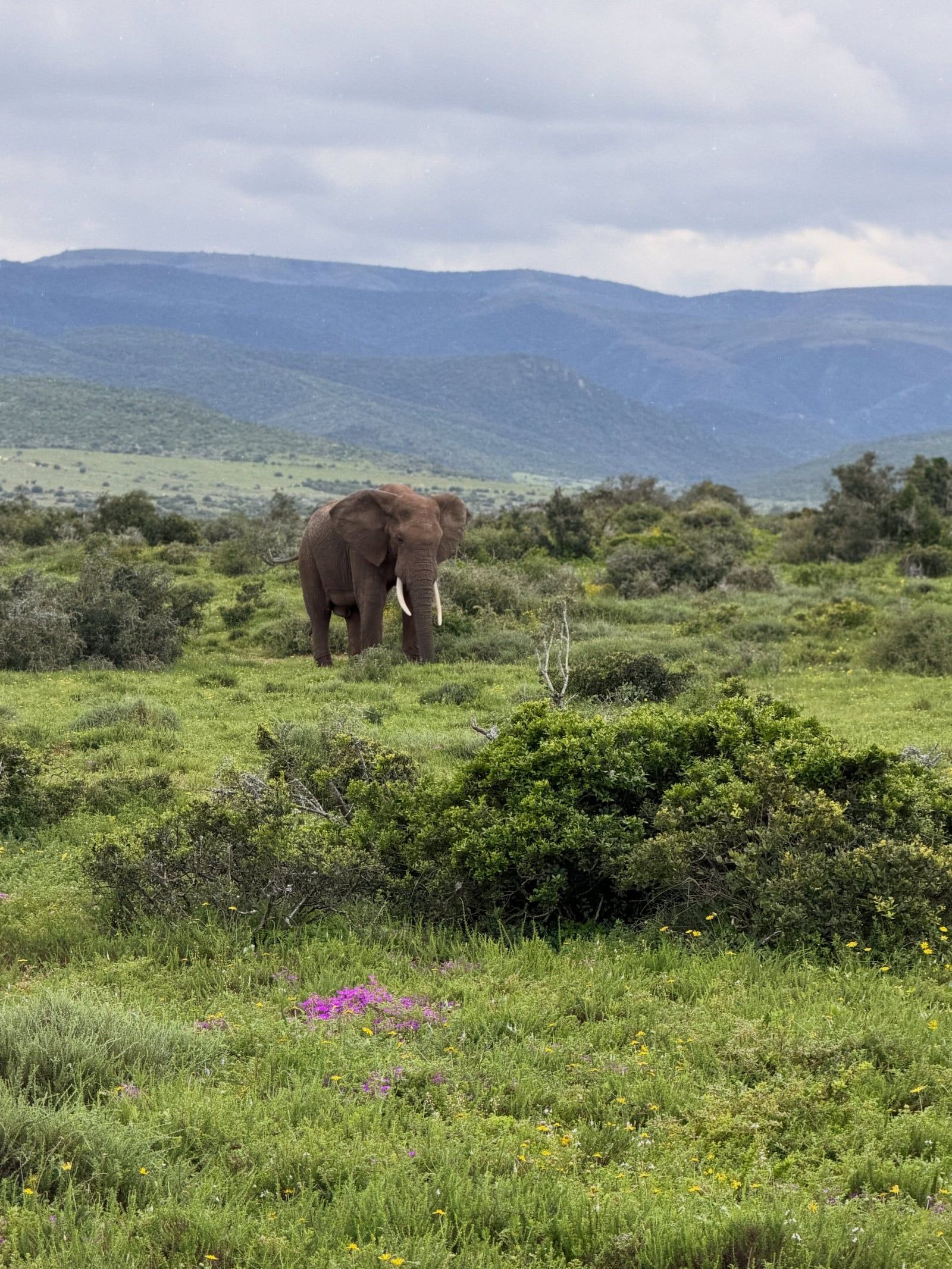
In June 1919, Major P. J. Pretorius was hired to shoot the Eastern Cape's elephants after local farmers complained of crop and stock losses. By August 1920 he had killed around 120 of them. A population of roughly 130 fell to 16. The outcry that followed pushed the government to act, and on 1 August 1931 it proclaimed Addo Elephant National Park over 2,270 hectares of valley bushveld — a patch smaller than many private farms — to shelter the 11 elephants still alive. Every elephant in the park today descends from those 11 animals.
Protection worked, slowly at first and then decisively. The herd grew from 11 to more than 600, and current park materials cite 800-plus. Addo's elephants are now so habituated to vehicles that breeding herds will graze within a few metres of a parked car — which is exactly what visitors come to see.
Expansion came piece by piece. The Zuurberg Mountains were added in the north, then Kabouga and Darlington Dam deep in the Karoo interior, then the Woody Cape section with its enormous coastal dune field, and finally a marine protected area around St Croix and Bird Islands. Each addition pulled new country under one boundary: arid Karoo, mountainous Zuurberg terrain, spekboom thickets, coastal forest and dunes, and open ocean. The park now covers about 1,640 km² — third-largest in South Africa — and the marine addition extended its remit from elephants to great white sharks.
Addo is now SANParks' flagship malaria-free Big Five reserve, and one of the most accessible national parks in Africa for international visitors thanks to its position at the eastern end of the Garden Route, an hour's drive from Gqeberha's airport. Lions and leopards patrol the main game area alongside around 400 Cape buffalo and more than 48 endangered south-western black rhino, while a bird list past 400 species spans all five biomes. The park's oddest celebrity is the flightless dung beetle, Circellium bacchus — one of the last places on earth where it survives in real numbers. Visitors watch them roll dung balls across the gravel roads, and the self-drive guidance is blunt: steer around them.
Addo runs from the Karoo to the Indian Ocean. In the north, the Zuurberg Mountains and Darlington Dam sit in dry, semi-arid country. The middle is the Sundays River valley, where dense spekboom — a succulent shrub that elephants strip relentlessly — covers the hillsides. The southern edge reaches the Alexandria dune field, roughly 40 km long and often cited as one of the world's largest coastal dune fields, before dropping into the marine protected area around St Croix and Bird Islands. Five of South Africa's biomes fit inside one boundary. Few parks pack that range into a single map.
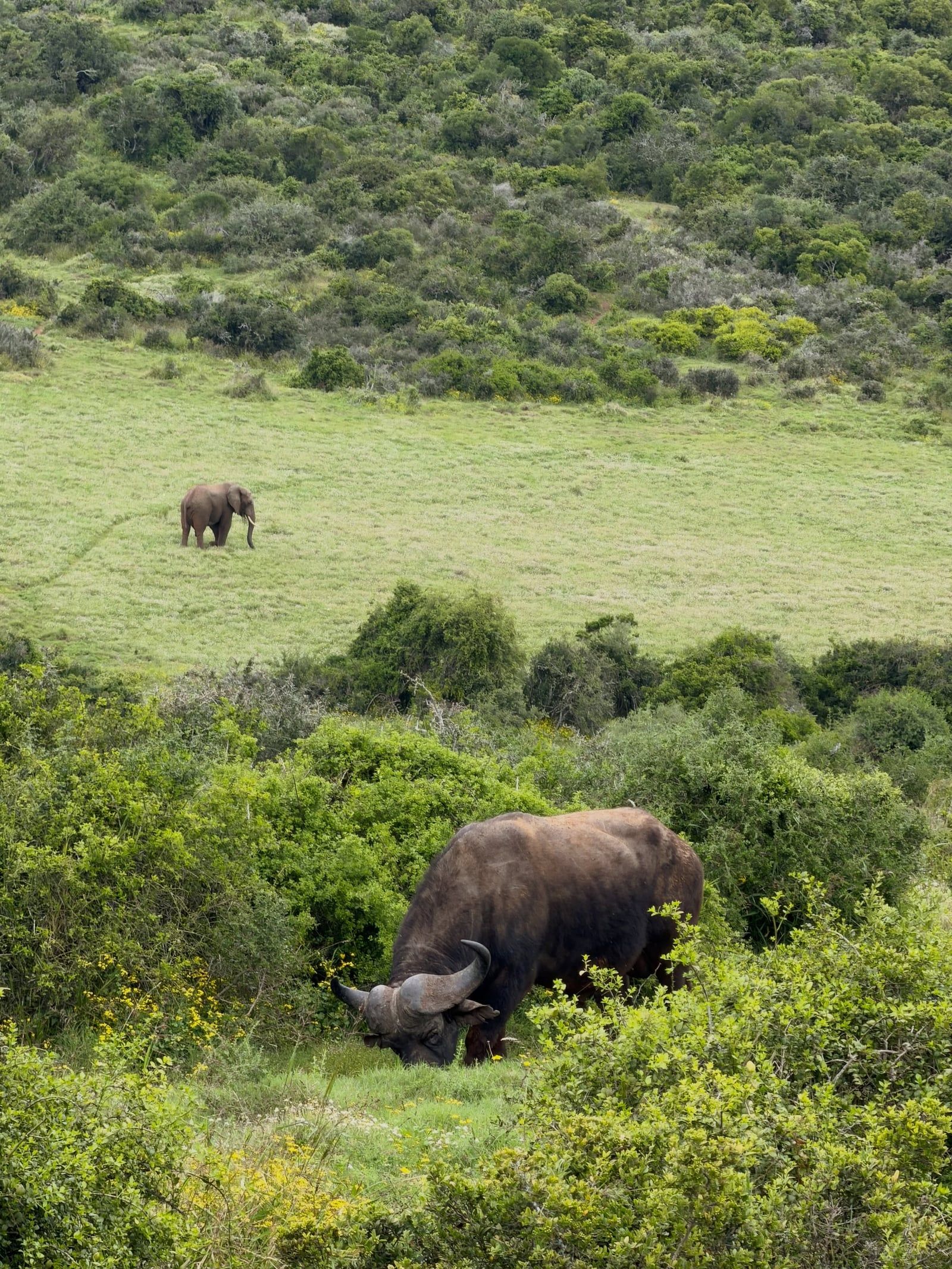
Nearly all game viewing happens in the southern inland section, where the road network and waterholes are concentrated. Hapoor Dam is the single best spot: on warm afternoons dozens of elephants gather to drink and cool off, with buffalo and warthog working the fringes. The roads are paved or graded gravel, fine for a sedan, with a 40 km/h limit that's legally enforced. Behind the fence live more than 600 elephants, around 400 Cape buffalo, 48-plus south-western black rhino, and lions and leopards that show themselves mostly at dawn and dusk. Back at Main Camp, an underground hide puts you at eye level with animals visiting the floodlit waterhole after dark, while lion, hyena and jackal call from somewhere out in the black.
The northern sections feel like a different park. Darlington and the Zuurberg are drier and mountainous, home to aardwolf, mountain zebra, gemsbok and springbok, and best reached on a 4x4 eco-trail or a full-day trip. On the coast, the two-day Alexandria Trail crosses the dune field through forested kloofs to a wild, undeveloped beach. Offshore, boat-based marine eco-tours chase the park's final two 'Big 7' members: great white sharks around the islands, and southern right whales when they pass in season. For birders, the SASOL Red Bishop Bird Hide at Main Camp overlooks a small wetland that pulls in weavers, bishops and other waterbirds — early morning is liveliest, so bring binoculars.
Addo's origin story is the Eastern Cape's own account of what nearly went wrong. Farmers and elephants had clashed for decades, and the park began, in effect, as an apology: 2,270 hectares set aside after a hired hunter had all but finished the herd. The citrus and stock farms that once demanded the elephants' removal still sit beside the park boundary, and today their region runs on elephant tourism instead. Towns like Addo village, Colchester — which bills itself as the 'Jewel of the Eastern Cape' — and the historic Zuurberg Mountain Village all base their visitor economy on the park next door.
The park has its own local celebrities. The flightless dung beetle appears in visitor guidance everywhere; drivers are told to steer around beetles crossing the gravel roads, and tourists who'd never brake for an insect anywhere else do it here. Neighbouring Amakhala Game Reserve, one of the few other places where the beetle survives, shares the same conservation story.
For South Africans, Addo is the standard first safari — malaria-free, sedan-friendly, and close enough to Gqeberha that a day trip almost always pays off. December and January fill the loops with school-holiday traffic, and SANParks even runs an annual free-access week that waives entry for South African citizens (7–13 September in 2026, park entry only). That accessibility is the park's real cultural role: it's the safari ordinary South Africans actually take, not the one they save up for.
Every one of Addo's 600+ elephants descends from the 11 animals alive when the park was proclaimed in 1931. A single hired hunter had cut the Eastern Cape herd from about 130 to 16 between June 1919 and August 1920.
The flightless dung beetle (Circellium bacchus) survives in only a few South African reserves, and Addo is its stronghold. It rolls dung balls weighing up to 50 times its own body weight across the park's roads.
Addo's marine protected area around St Croix and Bird Islands adds great white sharks and seasonal southern right whales to the Big Five — one of the few parks on earth managing elephants and great whites under one system.
From Karoo shrubland around Darlington Dam to open ocean, roughly five of South Africa's biomes fall inside Addo's ~1,640 km² — making it the country's third-largest national park.
The Alexandria coastal dune field in the park's Woody Cape section stretches roughly 40 km and is often cited as one of the world's largest. The two-day Alexandria Trail crosses it to a wild, undeveloped beach.
An underground hide at Main Camp puts visitors at eye level with animals coming to drink at the floodlit waterhole after dark, while lion, spotted hyena and jackal call in the distance.
SANParks runs an annual free-access week that waives park entry for South Africans — the 2026 dates are 7–13 September, with activities excluded.
Addo is famous for its 600+ elephants, which all descend from just 11 survivors protected when the park was proclaimed in 1931. It's a malaria-free Big Five reserve 72 km from Gqeberha, and its marine protected area lets it market the 'Big 7' — great white sharks and southern right whales added to the classic five.
Yes. SANParks states no immunisations are needed for the park because it sits in a malaria-free area, though insect repellent is recommended in summer as a general precaution. This is a major reason it's one of South Africa's most popular family safari choices.
The park was proclaimed on 1 August 1931 over just 2,270 hectares to protect the Eastern Cape's last elephants. It followed public outcry after Major P. J. Pretorius shot roughly 120 elephants between June 1919 and August 1920, cutting the population from about 130 to 16 — only 11 survived in the park at founding.
Lions, leopards, rhinos and buffalo are all present and seen regularly, though predators show themselves most at dawn, dusk or on night drives. The marine section adds great white sharks and seasonal southern right whales, making Addo a 'Big 7' destination. Elephants are the near-guaranteed sighting.
Yes — self-driving is Addo's signature experience and most routes are fine in a normal sedan, with some sections paved and the rest manageable graded gravel. You'll get a road map at the gate, must keep to the 40 km/h limit, and may not leave the roads. Only the northern eco-trails and some backcountry routes need a 4x4.
For 1 November 2025 – 31 October 2026, the SANParks tariff is R492 per international adult (12+) and R246 per child (2–11). SADC nationals pay R225/R112 and South African citizens R110/R54. Fees reset each year on 1 November, and Wild Card holders enter free.
May to September. The dry, mild winter thins the vegetation, concentrates animals at waterholes, and avoids the December–January school-holiday crowds. October to March is lusher and better for birding, but midday game is less active and the bush is thicker.
Most visitors spend a full day (8–9 hours, gate to gate) self-driving the main game area. Allow two to three days if you also want the Zuurberg Mountains, Kabouga, Darlington Dam, the Woody Cape coast or a marine eco-tour. A compressed half-day loop of 4–6 hours covers the Hapoor area highlights.
It's Circellium bacchus, a large beetle that cannot fly and rolls dung balls weighing up to 50 times its body weight. Addo is one of its last strongholds. Look for them trundling across the gravel roads during the day — the park's guidance is to drive around them, never over them.
The driver needs a driver's licence, every passenger over 18 needs ID or a passport, and the vehicle needs a valid licence disk. SANParks' rule is 'NO DOCUMENT means NO ENTRY'. Download and complete the gate registration and indemnity form in advance to speed things up.
Browse verified tours with free cancellation and instant confirmation.
Find Tours